

Whether you should get a facelift or blepharoplasty first depends on which area of aging most affects your overall appearance. If sagging along the jawline and neck is your primary concern, a facelift may be the better starting point. If heaviness or puffiness around the eyes makes you look tired, eyelid surgery is often addressed first.
Ultimately, the decision comes down to facial balance and anatomy. Understanding the distinct role each procedure plays can help you determine the most strategic starting point.
What Are the Benefits of a Facelift and Blepharoplasty?
A facelift and blepharoplasty target entirely different areas of the face. Although both can create a more youthful appearance, they address distinct structural concerns.
Facelift
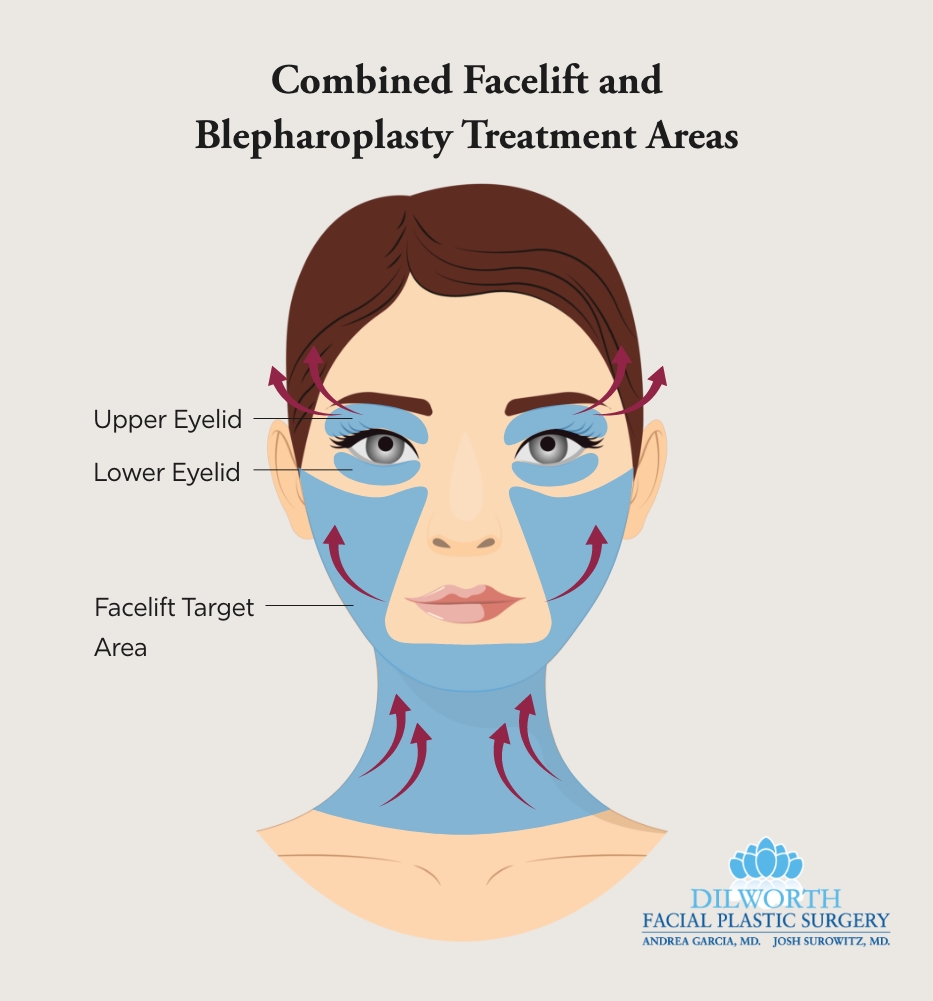
A facelift focuses on the mid-to-lower face and neck. It:
- Restores definition along the jawline
- Reduces jowls
- Lifts sagging cheeks
- Tightens loose neck skin
Modern techniques reposition deeper facial structures—not just the skin—creating results that look natural rather than pulled. You can learn more about how a facelift can turn back the clock in our earlier blog post.
Blepharoplasty
Blepharoplasty, or eyelid surgery, focuses exclusively on the upper or lower eyelids, or both. It:
- Removes excess skin
- Repositions fat when necessary
- Reduces puffiness
- Smooths under-eye bags
Because the eyes are central to facial expression, even subtle refinements can dramatically change how rested and alert you appear. Explore whether you’re a good candidate for blepharoplasty.
When the Eyes Are the First Sign of Aging
For many patients in their 40s and early 50s, the area around the eyes is the first to show signs of aging that can’t be fixed with cosmetic injectables. Upper eyelid skin may begin to droop, creating a hooded appearance. Lower lids can develop puffiness or persistent under-eye bags that make you look tired, even on your best days.
In these cases, eyelid surgery is often the logical first step. It’s a targeted procedure with a relatively straightforward recovery. Most patients feel comfortable returning to social activities within about 2 weeks. Our eyelid recovery timeline outlines what to expect if downtime considerations are part of your decision-making process.
When the primary concern is looking tired rather than sagging overall, blepharoplasty can offer a meaningful improvement without addressing the lower face at all.


When the Lower Face Is Your Primary Concern
Even if the eyes still look relatively youthful, the lower face can begin to change proportion, with a softening jawline, descending cheeks, and sagging neck. In these cases, a facelift often creates the most noticeable improvement. That’s because skin laxity in the lower face affects your overall facial structure. Correcting it restores contour and balance in a way that eyelid surgery alone cannot.
It’s important to understand that a facelift does not improve the eyelids. If heavy upper lids or under-eye bags are present, they remain unchanged unless addressed separately. Likewise, blepharoplasty does not lift jowls or tighten the neck. These procedures are complementary, not interchangeable.


What Makes the Bigger Impact?
Patients often ask which surgery will make them look “more” refreshed. The honest answer depends on what bothers you most.
If friends frequently ask whether you’re tired, even when you feel rested, your eyes may be the dominant issue. If your reflection looks older overall, particularly when seen in a profile view, a facelift may be the more impactful starting point.
Improving one area often highlights aging in another. For example, after eyelid surgery, some patients become more aware of sagging along the jawline. Think of how upgrading one room of your home can make other rooms appear dated. This is why a comprehensive consultation is so valuable. It allows us to assess facial balance rather than focusing on one isolated feature.
Should You Combine a Facelift and Blepharoplasty?
Many patients ultimately choose to address both areas at once. Combining procedures offers the advantage of a single recovery period and a more harmonious result. Because facial aging rarely happens in isolation, treating the eyes and lower face together can create a more complete rejuvenation.
That said, staging procedures are also reasonable. Some patients prefer to start with eyelid surgery and consider a facelift several years later. Others prioritize the facelift first and address the eyelids at a later time. There is no universal sequence, only what aligns best with your anatomy, health, and personal goals.


How Recovery May Influence Your Decision
Recovery is another practical factor. Eyelid surgery typically involves swelling and bruising for about 7 to 10 days, with social recovery around 2 weeks. Facelift recovery generally requires closer to 2 to 3 weeks before most swelling and bruising subside, with continued refinement over several months.
If your schedule only allows a short recovery window, that may influence which procedure you pursue first. However, recovery should be balanced with long-term strategy rather than serving as the sole deciding factor.
Planning Strategically
When deciding whether to undergo a facelift or blepharoplasty first, it helps to ask yourself one simple question: What bothers me most when I look in the mirror? Is it the heaviness around the eyes? Or is it softening along the jawline and neck?
At our practice, we thoughtfully design surgical plans to achieve proportional, natural-looking results. Our consultations focus on understanding your facial structure, skin quality, and long-term goals. Rather than recommending a one-size-fits-all approach, we design a plan tailored to you, whether that means eyelid surgery first, facelift first, or a combination of both.
Scheduling a personalized evaluation is the best way to determine which path is right for you. With the right plan, facial rejuvenation can restore not only definition and smoothness, but also confidence in the way you present yourself to the world. Request a consultation at Dilworth Facial Plastic Surgery using the online form or call us at (980) 949-6544.
Leave a Reply